

It's all a lie: you DON'T have to be "original"
Myths you debunk when you embrace true creative living.

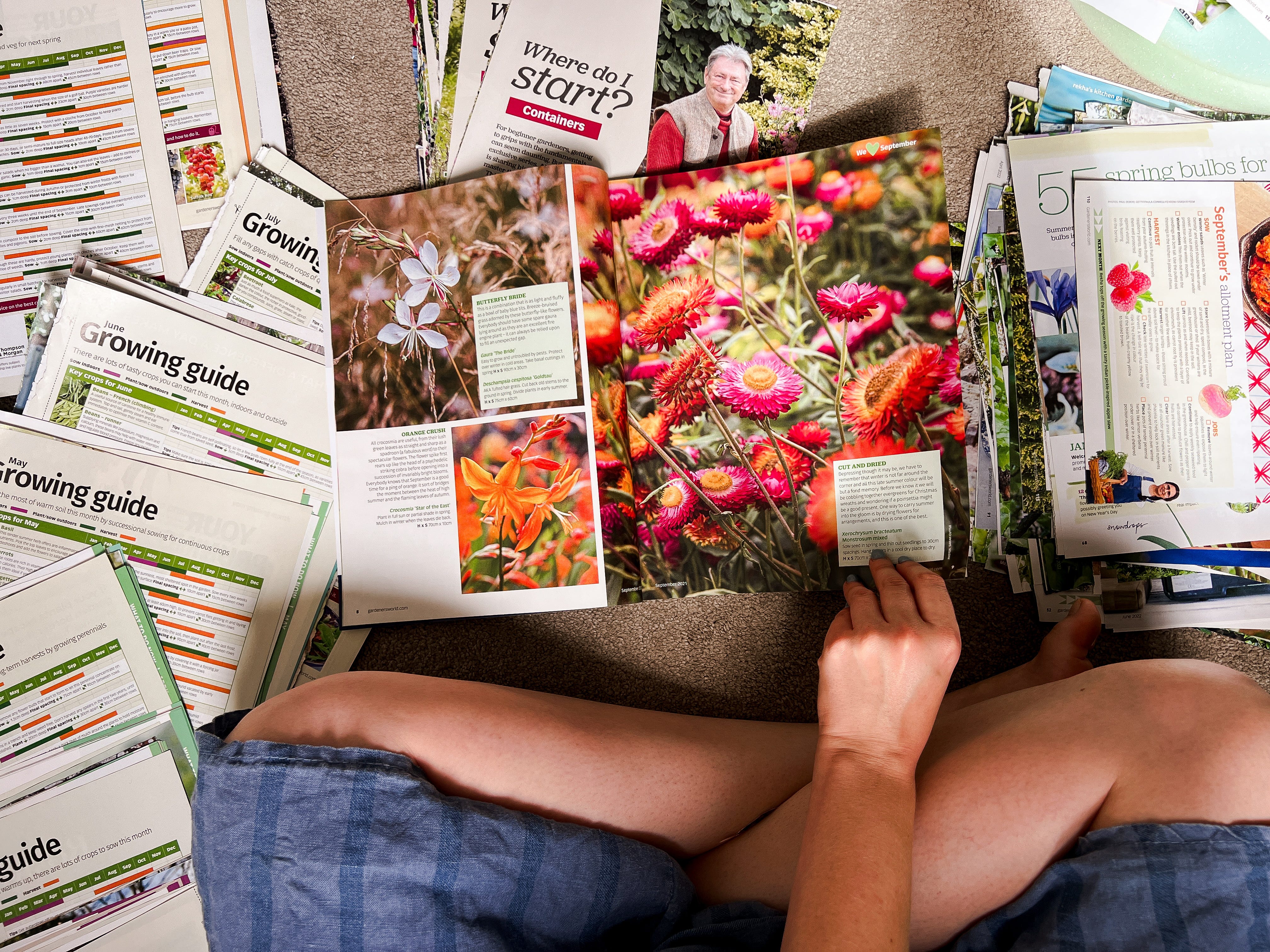
I sat on my office floor yesterday, clipping out magazine articles from my old collection of Gardener’s World, sobbing.
Back during lockdown, I would watch Monty Don greet us through the telly in his soothing voice: “Hello, and welcome to Gardener’s World.”
I’d lose myself in the sanctuary of other people’s gardens while I sat, locked away in a tiny 19th-century cottage with no yard or outdoor space.
I always wanted to be a gardener. So I subscribed to the Gardener’s World magazine, hoping to learn about propagation and soil quality while I waited patiently to have my own garden one day.
But when we finally moved, I was too bogged down in depression and overwhelm and autoimmune difficulties to touch the green space. And then, as I came out of the depression, I honestly just felt like a fraud. So many of my closest friends were incredible gardeners, but I grew up in a desert. I knew nothing. None of the names for my local plants or wildlife. The colour green, after all these years, is still a novelty to me.
And also… there was something deeper going on: a resistance which I didn’t realise was bubbling beneath the surface until last Sunday, when I started to read the coffee table book on gardening that I’d received with my Gardener’s World subscription (a subscription which I’d long since cancelled due to… you know… being a fraud).
As I read all about the impact of climate change on our gardening habits, as I looked at photos of Monty’s dogs who I knew had since passed away, I realised that gardening inherently brought a deep grief to the surface — because gardening forces you to engage in the rhythms of life, which means it also forces you to acknowledge the sting of death. And I didn’t want to do that.
Nevertheless, in the last few months, I’ve felt an ache to create beauty in front of our house, so I’ve started to learn how to garden, which lead to me pulling out all those old magazines I’d never read, clipping out useful articles and putting them in a binder. And while I did, I listened to an audio book about trees — about how trees and gardening are so deeply connected to our understanding of God, culture, place, life, and death.
The God of the Garden by Andrew Peterson (which is for sure making my list in next month’s edition of The Grammarian newsletter) literally takes you through a deep river of beauty as it links Andrew’s personal story to the connection he feels with place — and specifically with gardening.
As he trails through various chapters in his own life, he references so many of my own favourite books and authors, drawing parallels between suffering, hope, death, and the gospel in a way which felt eery. It was as if Peterson had gotten inside my head — had dissected my grief, my values, my pop culture preferences. Honestly, apart from his own personal story, it was as if I could have written this book myself. His longing for hope. His ache in the shadow of darkness. His desire to see the resurrection. All of it echoed the cry of my own heart.
He unpicked and reordered my thoughts, and then he handed them back to me in a way which had me crying on my office floor, worshipping Jesus and grieving death and feeling so incredibly seen.
And suddenly, it struck me: the reason that this book resonated so deeply is because Andrew used his own story to explore themes that have already been explored over and over and over again.
Very little of what he said was original. He was another middle-class American who plays guitar and reads C.S. Lewis, Tolkien, and MacDonald. He is not the first, nor will he be the last, to draw parallels between gardening and the gospel. He is not the first to use trees as a metaphor that explains our own sense of place to us. He is one of millions to complain that industry and consumerism have robbed us of the communal living for which God designed us.
Yet, this unoriginality didn’t stop him from writing his beautiful book, and in its lack of uniqueness, I felt uniquely seen. No longer a fraud but a “beholder” of the beauty which I was invited to grieve and cultivate. I felt allowed to call myself a gardener.
And suddenly, I realised that we’ve been sold a lie.
I can still hear the early 2000’s romcom line ringing in my ears, spoken in a dreamy London accent to a young Amanda Bynes:
“Why are you trying so hard to fit in when you born to stand out?”
What a Girl Wants was one of many films that would be oddly prophetic for me as it depicted that awkward, charming American girl just trying to find her way in a “prim and proper” English culture.
But while 14-year-old Christina loved theses films because they provided an escape to the country she would one day call home, the stories themselves also reinforced another message that many young women unknowingly absorbed: your value is in your ability to be different.
Now gents, stick with me here. This essay isn’t a feminist breakdown of the male gaze or one of the many other literary tropes on gender. But I only possess the ability to write from my perspective as a woman, so I have to start with the messages I absorbed as a kid — which were tailored towards women. Any lads who would like to chime in with their own stories, do feel free!
As a woman, I was met with the same “you’re not like other girls” caricature in the form of another quirky, clumsy, bookish, colourful, loud, artistic, academic, ditzy, clever, socially awkward, (insert whatever other adjective you fancy here) heroine who only gains confidence when some male love interest affirms that she is “different.”
And while I could explore the knock-on effects that such a message has on various aspects of our identity, I’m interested in one particular area: what the pressure to be “different” has done to our creativity.
I was told to be “different” so that I would “stand out” and gain the attention of the hunky jock (which, btw, eew), but are we not all told that we need to be “different” in order to make our art stand out?
“What’s your unique selling point?” they ask of businesses and artists alike.
“What can you bring that’s new to the conversation?”
“Why would someone want your book/landscape painting/acoustic album when the market is already so saturated?”
Let me just pause here for a moment and say that there IS a time and place to have these conversations. Understanding our USP (unique selling point) if we want to make any sort of income with our work is an important piece in developing confidence around our messaging and sense of purpose.
*Cue record scratching noise.” Buuut it’s also kind of a lie. And as an artist, I’m emotionally and mentally exhausted after trying so hard to be “different.”
(Ironically, I’d just like to point out that even this “epiphany” I’m having is entirely unoriginal. King Solomon got there first: What has been will be again, what has been done will be done again; there is nothing new under the sun. Ecclesiastes 1:9).
This epiphany is yet another area of freedom that I’ve found after shedding off the identity that I had once embraced as an Enneagram 4. Back when I used the Enneagram, one of the deepest things that resonated with me about the Type 4 (apart from the 4’s jealousy of other creatives) was the INTENSE need to feel unique, to stand out, to be seen as different. And every. single. Christian Enneagram coach I came across gave me the same solution to this deep ache: “You can rest secure in knowing that you’re unique in the eyes of God.”
And like, yeah. Cool cool cool. I am unique in the eyes of God. He knew me before I was formed in my amazing mother’s womb. He calls me by name. He knows the number of hairs on my head.
Everything that the Enneagram fed me as a solution for my originality-complex was true — but it didn’t actually give me rest. Because it wasn’t the truth I needed for this particular struggle.
The real truth I needed? The one that actually offers me rest? It’s much less sexy, but way more beautiful:
We don’t have to be original to be worthy. In fact, we create the most beauty when we allow ourselves to be absorbed in the truth and goodness of a Grander Story.
You, friend, do not need to be unique to be beautiful, talented, credible, or worth listening to. In fact, I have a theory that this lie about originality is actually a sly little plot from the enemy to push us further away from each other rather than bind us together in unity and glory and Body-of-Christness. If we approach things with the posture of wanting to DISTANCE ourselves from others, we’re doing the OPPOSITE of what art is designed to do: foster CONNECTION.
How can we possibly create artistic space for people to feel seen or to resonate with our work if we’re fighting so hard to “not be like other artists”?
Do you know what a freaking RELIEF it is for me to realise that I am not the only C.S. Lewis podcaster in the world? Do you know what a JOY it is to see how many other artists are rising up and re-claiming creativity as an act of evangelism and worship? My lack of originality is proof (from a business perspective) that there is actually a market for the work that I do and (from an artist’s perspective) that my art is actually going to have the desired impact because it will resonate with others.
What if, instead of being told that we can rest securely in “being original to God,” we can instead rest securely in knowing that we BELONG? Not just to God but within the Body of Christ. Because there are other people, just like you, who sing the same song. Whose voices rise up with yours in a chorus of communal glory and worship that lifts to Heaven like sweet incense.
What might this epiphany do for your imposter syndrome? If you truly realised that it’s okay — no, it’s bloody brilliant — that you are not the only one with a particular message on your heart? Instead of being intimidated by another artist who is doing the same thing that you do, might you realise that you have clearly been invited by the One Voice of the Holy Spirit into some deep, powerful, beautiful mystery? Isn’t that way cooler than being “different”?
I wonder how it might be for us as Christian writers/creatives/whatever you want to call yourself if, instead of focusing on creating something “unique,” we simply focused on doing our craft really, really well. What if we released ourselves from the pressure of “originality” and instead recognised that beauty doesn’t come from something being “different” but from being good and true?
Think about it: have you EVER looked at a beautiful oak tree and thought “That’s not beautiful. I’ve seen one before.”
Have you ever admired a woodland or a flower meadow and criticised it for how many of the same tree or flower it possessed?
Have you ever complained that your favourite chocolate chip cookie tastes like all the other delicious chocolate chip cookies you’ve ever tasted?
No! Because when something is good, it’s just good. When it’s beautiful, it’s just beautiful. We cease to compare when things unapologetically are what God made them to be.
What if we exchanged the pressure to “stand out” with the sweet embrace that comes from belonging to a global family, unified by the One True God?
How might that change your imposter syndrome, your stress, your approach to your art?
I don’t know, guys. It just sounds like freedom to me…
All my love,

P.S. If you want to get a monthly dose of beauty sent straight to your inbox, I run a newsletter curating not just a roundup of my content but of beautiful essays, podcasts, and books by others creators to inspire you and reignite your own creative writing spark. It’s called The Grammarian, and you can get it for free here.
P.P.S. Also, if you’ve ever wondered what the difference is between colons and semi-colons (and honestly just punctuation in general), you can sign up for my free email course where I teach you punctuation in a joyful, low-pressure, non-judgey way. Grab my Swordsmanship course for free here.
Oh, and finally, if you read this, and you’re still dealing with imposter syndrome with your writing, I made a journalling devotional just for you. You can get it for £14.95 in my shop here.
I have no words. Just a deep, deep, deep sigh of relief. Thank you for these words. They are in many ways an answer to a prayer I’ve been praying lately. ❤️
This whole article is gold 🪙✨ So much richness and truth, thankyou 💛